
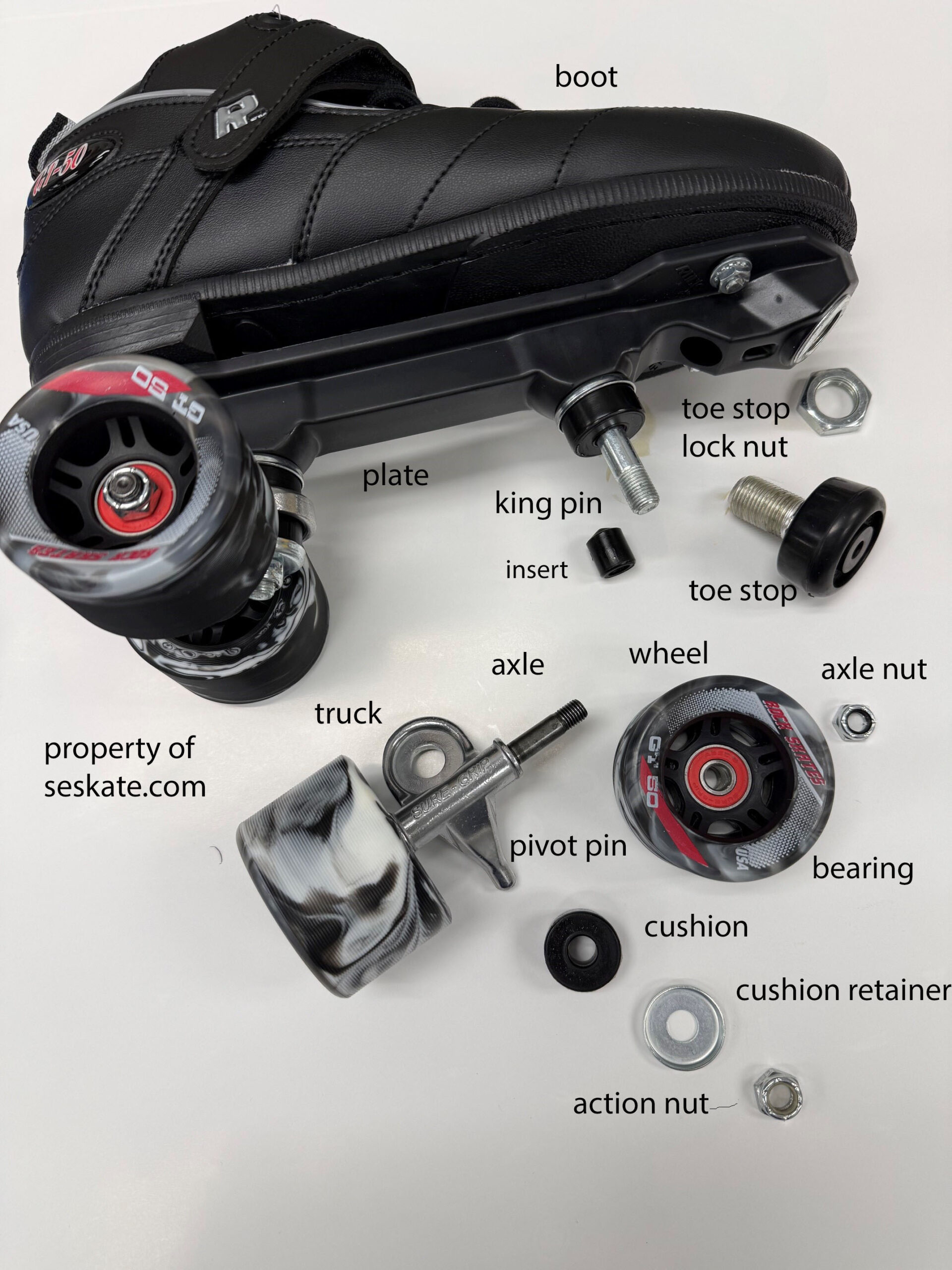

This is designed to explain, label, and name the different parts of a roller skate. There are many different types of skates, some may be a bit different, there are always exceptions, but in general, these are the basic parts of a skate.
ACTION WASHER (not pictured) – Not on all skates. But some plates will have a small washer between the action nut and the cushion retainer. They’re normally pretty thin.
ACTION NUT – The nut that goes on the king pin and holds the truck, cushions, king pin, etc., in place. You can tighten or loosen the action nut to control how easy it is to turn the skates. Just be careful not to loosen it too much while skating, you don’t want it slipping off, as your truck could fall off.
AGLET – The tips of laces are called aglets. They’re a little harder than the lace and are used to keep the laces from fraying and to make it easier to get the laces into the eyelets. They can sometimes be replaced, but the parts and the tool to do this aren’t easy to find, most people will just replace the lace instead of working on the aglets.
AXLE – The part of the truck that the wheel sits on. They’re long and thin with a threading on the ends of them to accommodate the axle nut. Almost all are going to be 7mm or 8mm sized, and this will determine what size bearing you need and also what size axle nut you need.
AXLE NUT – The nut on the end of the axle that keeps the wheel from falling off. They come in 7mm or 8mm size, you need to get one that matches your axle. Sometimes called a 45A nut.
BEARING – The small piece that sits inside the wheel and helps the wheel spin on the axles. Almost all skate wheels will have two bearings per wheel. The outside diameter size is almost always the same, and will the bearings to fit inside the wheels. The inside diameter will almost always be one of two different sizes, and this will need to match the axle on your skate. The 7mm size is less common, and will sometimes be referred to as a 9/32” size or a 627 size. The 8mm size is more popular, and will sometimes be referred to as a 5/16” size or a 608 size.
BOOT – You can probably figure this one out. The part that your foot goes into. Some are lower cut (sometimes called “speed boots”) and some are higher cut (sometimes called “art boots”).
CUSHION – A soft part of the truck that the king pin slides through. It is shaped like a donut, with a hole in the center. Some plates will have two cushions per truck (called a double action truck) and some will have one cushion per truck (called a single action truck). On some of the nicer plates they will come in different hardnesses so that you can adjust how much “play” your truck has when you turn. In general, heavier skaters will prefer a harder cushion, lighter skaters will prefer a softer cushion. But this is a preference thing and skating style, weight of the skater, etc., can all influence this. Some skates offer cushions in different colors, sometimes this will indicate the hardness of the cushion, sometimes this will just be a style option.
CUSHION RETAINER – A disk, almost always metal, that holds the cushion in place and keeps it from rubbing up against the plate or the action nut.
EYELET (not shown) – The holes that laces go through. Sometimes you’ll hear the term grommet for the reinforcement piece on the eyelet.
INSERT – A small piece that fits into the base plate and is shaped like a thimble. The pivot pin of the truck will slide into the insert. They’re typically rubber, but occasionally you’ll see a metal version.
INSOLE (not shown) – These go inside the boot to provide padding to your feet. They can typically be removed and are often upgraded. You can use a thicker insole to provide more padding and also to eat up a bit of space if your boot is slightly too big for your foot. You’ll occasionally see something called a boot liner that goes up above the ankle, almost like a sock. But most skates use a simple insole.
KING PIN – The main bolt in a plate that the truck will attach to. A “reverse action” king pin (as shown in this picture) comes down from the plate and is attached via an action nut at the bottom (as you skate) of the king pin. This is probably the most popular version on newer plates. There are also some where the king pin will screw into the plate and held together via an action nut closer to the base plate.
LACES – The strings that help tighten the boot. You can swap out colors to give your skate some personality. Lower cut or smaller boots will have shorter laces (72” is a popular size for speed boots) and higher cut or bigger boots will have longer laces (81” or 90” are popular sizes here). The number of eyelets has a big impact on how long of a lace you’ll need.
PIVOT PIN – The part of the truck that slides into the plate via the insert. It is usually attached to the rest of the truck as one piece, but sometimes (typically on higher end plates) it is removable from the rest of the truck. It is occasionally adjustable to expand a tiny bit to help adjust for how tightly your truck is attached.
PLATE – The plate goes between the boot and the wheel on your skates and holds everything together. Sometimes you’ll hear the term “base plate” for just the main part of the plate and “complete plate” for the base plate plus the king pin, insert, truck, cushions, etc. The plates can be made of plastic or metal. Some assume that a metal plate is better, but plastic can be lighter and also more durable than many of the metal plates.
TOE STOP – The piece that goes in the front of the plate to help you start or stop. There are two sizes of holes that the toe stop will slide into. The 5/8” size toe stop uses a larger hole and is the type shown in this picture. These are sometimes called “adjustable toe stops”, as you can adjust how low the toe stop hangs down by screwing it further into the hole on the plate. These are often held in place by a toe stop lock nut (shown) but on some plates are held in place by a toe stop allen screw, which will be tightened to slightly compress the hole the stop goes into.
The other common size is a 5/16” toe stop. These are held into the place with a loose screw that goes through the center of the toe stop. With this style of stop you can’t adjust how low the toe stop hangs down from the plate, so it is sometimes called a “fixed toe stop”.
Some people will choose to replace the toe stop with a toe plug, which is basically a very small toe stop that will screw into the plate snugly and take up a lot less space. Some advanced skaters like these as they’re lighter and don’t get in the way when you’re doing some tricks on skates. They’re not recommended for beginner skaters who will usually prefer stopping and starting with a toe stop.
TOE STOP LOCK NUT – The nut that holds most 5/8” size stops in place. A few plates use an allen screw to tighten up or loosen the plate hole, but most use a nut like this picture.
TRUCK – The piece that goes between the plate and the wheels is called the truck. The term can mean the whole assembly (cushions, cushion retainers, action nut, king pin, axle) or it could mean just the smaller piece that everything fits into. So you’ll hear “complete truck” to indicate all of the different pieces, you’ll hear “truck housing” or “truck and axle” for just the main part without all of the other little pieces. So, it is a good idea to be specific here on what you’re referring to.
WHEEL – The round part of the skate that actually touches the skate floor. Most of the nicer ones are made of a urethane material. The size is measured in diameter, with 57mm or 62mm being popular sizes. The hardness of the wheel is measured by something called the durometer of the wheel. The higher the number of the durometer, the harder the wheel. Popular hardnesses are 78A through 97A durometers. The softer wheels (lower durometer numbers like 78A-85A) are going to be more popular outdoor, where the softness will help offset tiny bumps in asphalt or concrete skating surfaces. Harder wheels (higher durometer numbers like 95A-100A) are more popular for the super smooth surfaces you’ll see on a skating rink floor.
